
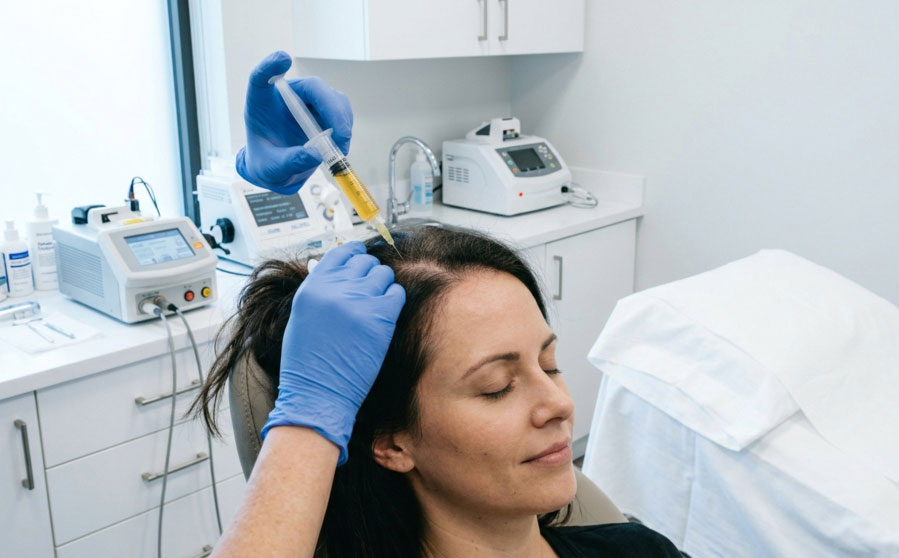
Losing your hair can be frustrating, particularly if you find that it’s thinning even after you’ve tried a number of different products. One treatment that is gaining more attention is platelet-rich plasma (PRP) therapy. What’s interesting is that the PRP is derived from your own blood. But does this mean that PRP can treat hair loss? Not really. Studies show that PRP can help certain people with certain kinds of hair loss, but it’s not a one-size-fits-all treatment. Knowing how it works and what the evidence says can help you decide whether it may be suitable for you.
PRP Therapy for Hair Loss: What Is It?
Platelet-rich plasma (PRP) uses a small amount of your own blood and has a higher concentration of platelets than normal blood. Platelets are a major component of blood and play a role in tissue repair and growth. These platelets release growth factors that can help with tissue healing and regeneration. The idea is that PRP injected into the scalp for hair loss could enter the hair follicle area and stimulate dermal papilla cells involved in hair growth.
What Is PRP Made Of?
The process is pretty simple – a little blood is taken from your arm and spun in a centrifuge. The machine spins the blood at a high speed and separates the blood into its different components. Then the platelet-rich part is separated. Sometimes the blood is spun again to increase the concentration of platelets. The prepared PRP is then injected into various areas of the scalp where thinning of hair occurs.
Does PRP Help Hair Loss?
PRP has been studied primarily for androgenetic alopecia, also known as pattern hair loss or hormone-related baldness and can affect men as well as women both. For men, thinning often occurs at the front and top of the scalp. Thinning in women often occurs around the top and crown and the part may gradually get wider. According to research, PRP may be more effective in androgenetic alopecia when combined with other therapies such as topical minoxidil or oral finasteride. However, there isn’t enough evidence to suggest PRP works as well for all types of hair loss. There is still more research needed for conditions such as telogen effluvium, alopecia areata and scarring hair loss.
How Many PRP Sessions Are Usually Needed?
PRP sessions are often required 3-4 times. PRP is usually not a one-time treatment. The treatment plan usually consists of three sessions spaced about a month apart, followed by maintenance sessions every three to six months. But the exact plan may vary from person to person. Your dermatologist can evaluate your hair loss, determine if PRP is appropriate and how often you may need the treatment.
Is PRP Safe?
PRP is generally regarded as safe when performed by a trained dermatologist because the treatment uses your own blood. But some temporary side effects can happen. These can include pain, redness, headache and temporary loss of hair. PRP may also not be right for everyone, including some with bleeding disorders or autoimmune conditions. That is why a proper consultation before treatment is important. PRP should not be thought of as a one-size-fits-all procedure for hair loss.
Why Is PRP Not a Cure for Every Type of Hair Loss?
Hair loss can occur for a variety of reasons. Pattern hair loss, stress shedding, autoimmune hair loss and scarring conditions are not the same problem. PRP has been more researched in androgenetic alopecia than in several other types of hair loss. Also, doctors currently use different methods of PRP preparation and administration. Thus, it is better to consider PRP not as a cure, but as a possible treatment option for certain patients.
PRP Therapy at DermaStation
Dr. Sumit Sethi, Dermatologist and Aesthetic Dermatologist at DermaStation provides hair and scalp treatments including Platelet-Rich Plasma therapy. It is important to know the reason for hair loss to choose the right treatment. A dermatologist will first look at your scalp and the pattern of hair loss before recommending PRP or any other treatment.
Why Book an Appointment with Dr. Sumit Sethi at DermaStation for PRP?
Not all causes of hair loss are the same, so treating it without knowing the cause may not give you the results you expect. PRP Therapy by Dr. Sumit Sethi is one of the best hair and scalp service providers at DermaStation. A consultation can help you decide if PRP is the right option for your type of hair loss or if another treatment or combination approach may be better suited. PRP is an interesting option for hair loss, especially pattern hair loss, but it is not a guaranteed cure. It is best to first figure out why your hair is thinning and then choose treatment based on that reason.
The most important step in finding the right treatment for hair loss is knowing what is causing it.